In general, there are 3 main types of propellants used: solid propellants, liquid propellants and hybrid propellants. Liquid propellants have their fuel and oxidizer (needed for the combustion to occur) kept in separate tanks. A system of pipes and valves connect these two tanks to a combustion chamber.
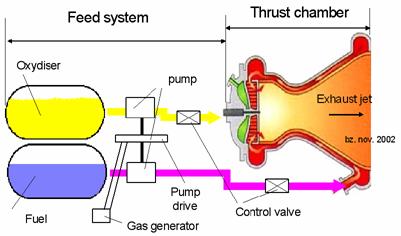
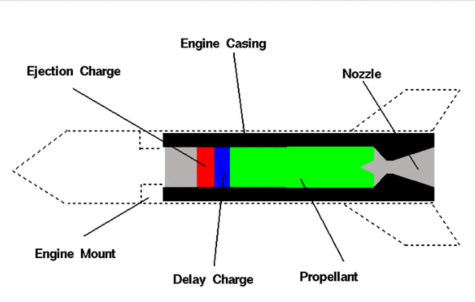
Although liquid propellant engines are much more complex than solid propellant engines, they offer a major advantage: flow regulation. As the flow of the propellant and the oxidizer can be controlled, the engine can be throttled. This also means that the engine can be started and cut off repeatedly. Solid propellant based engines are the simplest of all the engine designs. They have one chamber that contains a mixture of both fuels and oxidizers. Solid propellants burn at a rapid rate, and do not stop burning until all of the fuel mixture has been used up. In general, solid propellants are used in the boosters for the initial launch. Once the propellant has been used up, the boosters are detached, and the payload uses liquid propellants in order to enter orbits, as they are more reliable.
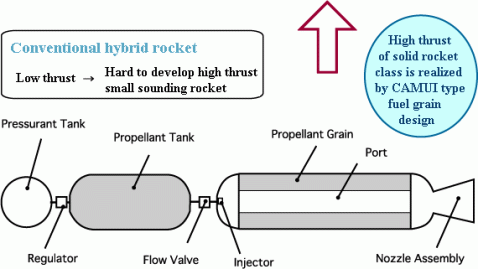
Hybrid propellants consist of one solid propellant (generally fuel) as well as a liquid propellant (generally oxidizer). The liquid is directly injected into the chamber with the solid fuel, rather than a separate combustion chamber. These engines have the high performance of a solid propellant engine and the throttle control of a liquid engine. However, it is difficult to design these engines for large thrusts, and therefore they are rarely used.
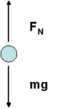
When the rocket is at rest on the launch pad, it’s Net Force is zero, and therefore the rocket does not move. The forces acting on the rocket would only be the Normal Force and the Force due to Gravity.
In order to leave Earth, the rocket’s applied force, thrust, must overcome the force of Gravity and accelerate upwards.
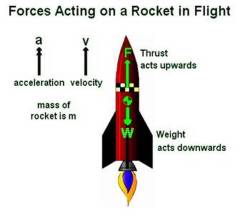
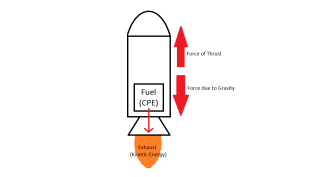
While the rocket is stationary on the launch pad, it has gravitational potential energy, and the fuel within the rocket has chemical potential energy. The chemical potential energy (CPE) is stored in the bonds of the fuel compounds. When the fuels undergo combustion, these bonds are broken to form new bonds. When the bonds are broken, the energy stored within them are released in the form of kinetic and sound energy. This increase in kinetic energy also causes the rocket to lose gravitational potential energy.
In order to escape from the gravitational field of Earth, an object must reach escape velocity. Escape velocity occurs when the kinetic energy is equal to the gravitation potential energy. The escape velocity from Earth’s gravitational field is approximately 11.2 kilometres per second.
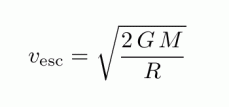
To the right is the formula for the escape velocity of a gravitational field. This equation is derived from setting the kinetic energy and gravitational energy equal to each other.
Rockets contain large amounts of fuel, most having multiple boosters, as they mus ACCELERATE to the escape velocity. As the rockets are both heavy and start from rest it takes a long time, and a large amount of fuel to reach escape velocity.
 Journey To Mars
You must be logged in to post a comment.