An orbit is the curved path an object in space takes when being accelerated by gravity. All of the planets are in orbit around the sun, and likewise, the Moon is in orbit around the Earth. Also, artificial satellites are in orbit around a parent body such as the Earth, Moon or Mars.
Orbits are usually classified by their path around the parent body and which parts of the parent body it passes.
Some of the ways orbits can be defined by their path include:
- Circular
- Elliptical
- Escape
- Capture
Some ways orbits can be defined by what parts of the parent body it passes over are:
- Equatorial
- Geostationary
- Polar
Circular orbits are the most simple type of orbit there is. It is defined simply by its radius from the center of the parent body. In this type of orbit, the centripetal force is provided entirely by the gravitational force. Because the orbit is circular, the speed is constant and is given by the following equation:

However, this is an ideal case. Normally, orbits follow paths called ellipses which are circles stretched out in the x direction.
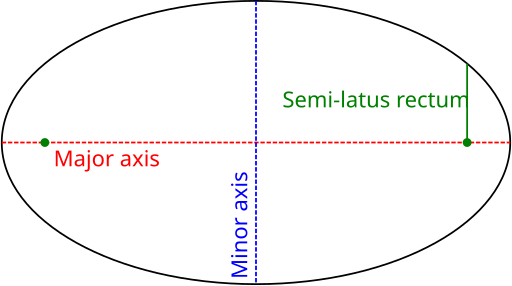
When an orbit is an ellipse, the heaviest body is one of the foci of the ellipse (the green points in the diagaram above)
During the Journey to Mars, a spacecraft will be in part of various orbits. First, it will launch from Earth into an elliptical Low Earth Orbit. This kind of orbit has a low periapsis and a high apoapsis. During this time, the spacecraft can ensure systems are ready and allows refueling and crew transfer close to home. Then, the spacecraft waits for something called a transfer window. This is when the positions of Mars and Earth are in a place where a Hohmann transfer is possible. At this point, the spacecraft will burn it’s engines and make an elliptical transfer orbit around the sun. This orbit’s apoapsis is at the right altitude for a Mars capture. When the spacecraft reaches the apoapsis, Mars will have reached this point as well and the spacecraft can begin a capture burn where the spacecraft is slowed down by its rockets and enters an elleptical orbit around Mars. Often, aerobreaking is employed so that fuel is saved.
 Journey To Mars