Over the last two weeks, I have continued my research on orbital dynamics and the process of getting to Mars. Moreover, I have expanded my knowledge about the different parts of orbits and requirements that a rocket must have in order to go somewhere in space.
First, I have learnt about Kepler’s 3 Laws of Planetary Motion:
- All planets move in elliptical orbits with the sun at one of the foci
- A line that connects a planet to the sun sweeps equal area in equal times
- The period squared is proportional to the cube of the semi-major axis
The first law states that the shape each planet/satellite orbits in is an ellipse. This is a type of elongated circle with two focus points. It also states that the body the satellites orbiting around stays at one of these foci. 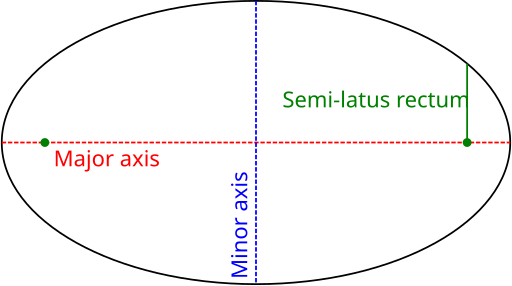
The second law states that if there were an imaginary line connected from the satellite to the main body, it would describe equal areas in equal times. This means that the closer an object comes to the body it is orbiting around, the faster it moves. 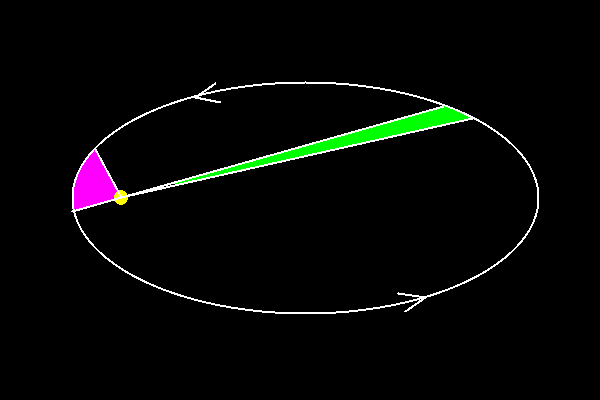
The third law describes a mathematical relationship between the semi-major axis of an orbit (half of the major axis, which is the line connecting the farthest parts of the ellipse) and the time it takes to complete a complete revolution.
In an elliptical orbit, there are numerous properties that can be seen:
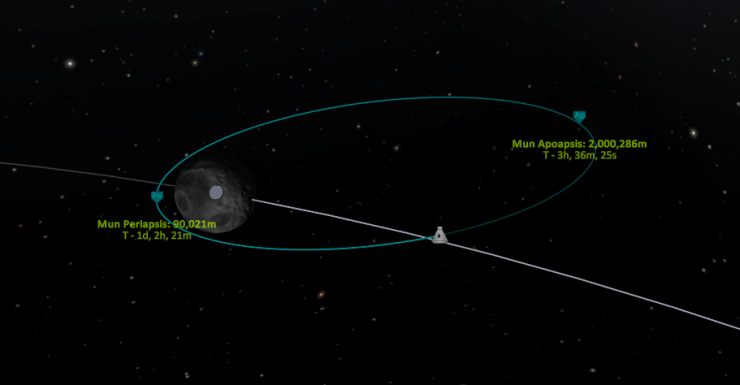
The apoapsis is the part of the orbit where the alititude is the highest and the speed is therefore the lowest.
The periapsis is the part of the orbit where the altitude is lowest and the speed is therefore the highest.
The semi-major axis is the sum of the apoapsis and periapsis divided by 2 (half the major axis).
The eccentricity is defined as how much a conic section (circle, ellipse, parabola, hyperbola) deviates from being a circle. Ellipses have eccentricities between 0 and 1 a circle has an eccentricity of 0.
The inclination of an orbit is the deviation from the equatorial plane. For example, a polar orbit that passes over both poles has an inclination of 90°.
In the image below, the apoapsis and the periapsis are labelled with Ap and Pe. This spacecraft is in an elliptical orbit around the Moon with an apoapsis of approximately 200 000 m and a periapsis of 90 000m. This means that the semi-major axis is 145 000m.
In the image below, the dashed orbit has a higher inclination than the blue orbit. 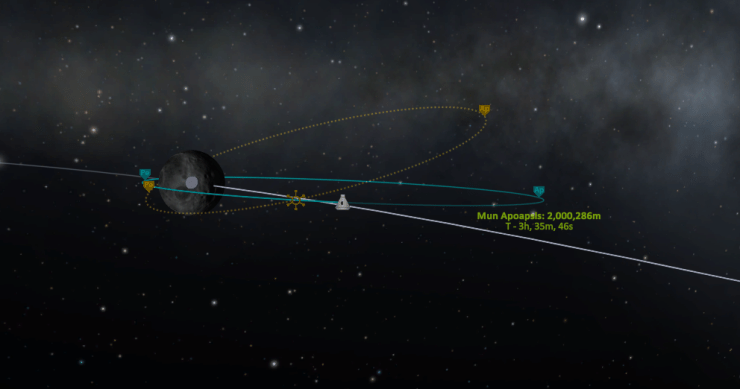
In the coming weeks, we will be porting our research into an easy to understand format on the website. We will share the information that we have learnt and make sure each page of the website reflects each of our knowledge appropriately. Also, we will continue making the video with Kerbal Space Program (the program used to create the diagrams of orbits above). We expect to finish the majority of the website by the first week of January and the video done by the second week of January.
 Journey To Mars
Leave a comment