As of my last blog I have expanded on my research into fuel systems and begun research into how craft and crew are to land on mars. My focus for fuel systems was the conversion of energy from one form to another. While the rocket is stationary on the launch pad, it has gravitational potential energy, and the fuel within the rocket has chemical potential energy. The chemical potential energy (CPE) is stored in the bonds of the fuel compounds. When the fuels undergo combustion, these bonds are broken to form new bonds. When the bonds are broken, the energy stored within them are released in the form of kinetic and sound energy. This increase in kinetic energy also causes the rocket to lose gravitational potential energy.
My next focus was on landing craft, specifically the landing maneuver and the aeroshell. As of right now the only things to have landed on mars are unmanned robotic probes, and their spacecraft. There are currently three developed methods of landing on mars; retrorocket touchdown, encasing the rover in a tetrahedron, and using a sky-crane. All three of these landing methods use an aeroshell and parachute sequence.
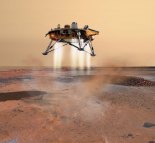
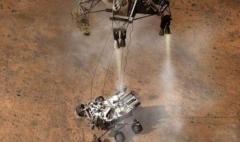

Retrorockets Sky-crane Tetrahedral Airbags
The aeroshell acts as a protective cover for the rover/craft during the landing sequence. Its main purpose is to protect the landing craft from burning up as the craft enters Mars’ thin atmosphere.
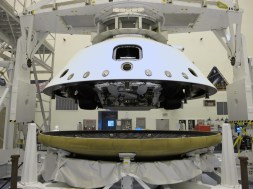
The aeroshell consists of the heat shield (brown piece) and the backshell (white cone). The heat shield protects the lander and rover from the intense heat from entry into the Martian atmosphere. The backshell contains the parachute as well as orienteering rockets and rockets to slow down the descent.
Once at Mars, an aerocapture maneuver will be used by arriving cargo and crew modules to enter Mars orbit. This maneuver will be performed with the use of a single aeroshell which will provide the aerodynamics and thermal protection needed for safe insertion into orbit. The main advantages of an aerocapture maneuver are the savings in spacecraft mass (an aeroshell will be lighter than a propulsive capture stage) and the elimination of one propulsive stage (thereby minimizing potential risk on entry). After successful capture into Mars orbit, a Mars descent maneuver will be performed and the same aeroshell will provide thermal protection for the descending module during atmospheric entry. Once the descending module has entered the Martian atmosphere and slowed down considerably, the aeroshell will separate from the module inside and parachutes and/or atmospheric propulsive maneuvers will be used to vertically deliver the module to the surface. Extremely accurate surface delivery will be required for all Mars surface payloads to ensure that all equipment intended for use by the astronauts is accessible upon their arrival.
Over the next week I plan to research into the different landing methods (sky crane, retrorocket touchdown, etc.)
 Journey To Mars
Leave a comment